How to Choose the Best Customer Service AI Chatbot for Your Business
Imagine it’s your busiest sales season.
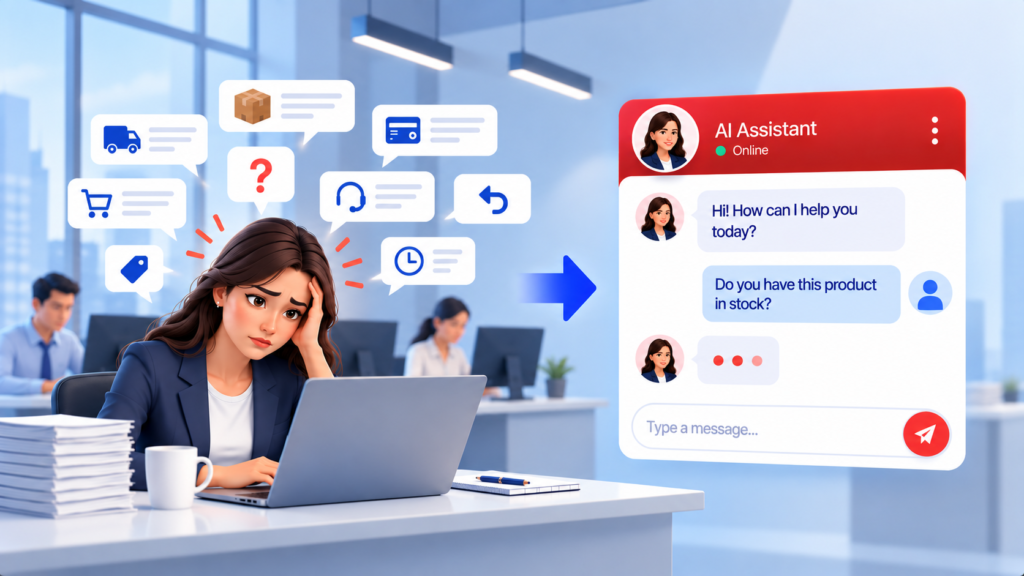
Hundreds of visitors are landing on your website every day, asking questions about delivery times, returns, payment methods, product availability, pricing, and support. As those conversations pile up, your support team struggles to keep up. Response times increase, customers become frustrated, and some leave before getting the answers they need. This is a challenge many businesses face today.
Customers expect fast answers, even outside normal business hours. And AI is quickly becoming part of how businesses meet those expectations. This is exactly where a customer service chatbot AI can make a real difference.
An AI chatbot can answer common questions instantly, help customers find information, capture leads, and hand conversations over to human agents when additional assistance is needed, but not every chatbot delivers the same value.
So, how do you choose the best customer service chatbot for your business?
1. Start With Your Business Goals
Before comparing chatbot features, identify the problem you actually want to solve.
- Are your support agents spending too much time answering repetitive questions?
- Are website visitors leaving without getting answers?
- Do you need support outside business hours?
- Do you want to capture and qualify more leads?
Your goals should determine the type of chatbot you choose. For example, an ecommerce business may need help with product questions, shipping, returns, and recommendations. A SaaS company might need a chatbot that answers product questions, qualifies leads, books demos, and provides technical support.
Starting with your business goals makes it easier to identify the features that actually matter.
2. Choose an AI Chatbot That Understands Natural Language
One of the biggest differences between traditional chatbots and modern AI customer service chatbots is their ability to understand natural language.
Traditional chatbots often depend on predefined questions, keywords, and scripted conversation flows. They can struggle when customers phrase questions differently from what was anticipated. For example, a customer might ask, “I opened the package. Can I still return it?” even though your knowledge base contains, “What is your return policy for opened products?”
A capable AI chatbot should understand that both questions have the same intent and provide the appropriate answer. Look for a solution that can understand natural language, maintain context across conversations, and ask clarifying questions when necessary with customer service AI chatbot.
3. Pay Attention to the Knowledge Base
Your AI chatbot is only as useful as the information it can access.
The best customer service AI chatbot platforms allow businesses to train their AI using existing information such as website pages, FAQs, PDFs, product documentation, and other business files.
Just as important is how easy that information is to update. Your business will change. Products, pricing, policies, and services will evolve. Your chatbot should be easy to update so it continues providing relevant answers without requiring complicated technical work every time something changes.
This is particularly important because AI performance depends heavily on the quality and availability of business data. A well-managed knowledge base can therefore make a significant difference to the quality of your chatbot’s responses.
4. AI should support your customer service team, not necessarily replace it.
Some conversations will always benefit from human assistance, including complex complaints, billing issues, technical problems, or sensitive requests.
A good customer service AI chatbot should recognize when it cannot provide the right answer and smoothly hand the conversation over to a human agent. The conversation context should also be preserved. Customers shouldn’t have to explain their problem again after being transferred. This combination of AI automation and human expertise is becoming increasingly important.
5. Look for Personalization
Customers don’t want to interact with a generic chatbot that feels disconnected from your brand.
Look for customization options that allow you to control the chatbot’s name, avatar, appearance, greeting messages, tone, and behavior. The chatbot should feel like an extension of your business rather than a separate tool simply added to your website.
Personalization is particularly important when the chatbot is handling sales conversations, product recommendations, or customer service AI chatbot interactions.
6. Check Integrations and Automation
Your chatbot shouldn’t operate in isolation. Consider how it will work with the tools your business already uses, such as CRM platforms, help desks, ticketing systems, scheduling tools, and other business applications. For example, a chatbot could collect a visitor’s information and send it to your sales team, create a support ticket when an issue requires attention, or help a prospect schedule a meeting. These integrations can turn a simple website chatbot into a broader customer service AI chatbot solution.
7. Measure More Than Response Time
Fast responses are important, but speed alone doesn’t tell you whether your chatbot is delivering value.
Consider metrics such as customer satisfaction, conversations handled, human handovers, leads captured, support tickets, response times, and customer feedback. You should also be able to review conversations to understand what customers are asking and where the chatbot needs improvement.
The goal isn’t simply to have an AI chatbot that responds quickly. It’s to have one that improves customer service and contributes to meaningful business outcomes.
8. Consider Security and Scalability
Customer conversations can contain names, email addresses, phone numbers, order information, and other sensitive data. Before choosing a customer service AI chatbot platform, understand how it handles data, access controls, privacy, and security.
You should also consider where your business will be a year from now. As your business grows, you may need more conversations, additional AI agents, multiple languages, more integrations, and greater automation. Choosing a scalable platform now can help you avoid replacing your chatbot later.
choosing the right customer service AI chatbot
Choosing a customer service chatbot isn’t about finding the platform with the longest feature list. It’s about finding a solution that fits your business, understands your customers, uses your own knowledge, works with your existing tools, and knows when a human should take over.
As you compare different AI chatbot for customer service solutions, consider evaluating HighEngage alongside other platforms. HighEngage brings AI-powered customer conversations, knowledge management, lead capture, human handover, live chat, feedback, tickets, and automation together in one platform.
Explore HighEngage and see how it compares with the requirements covered in this guide and whether it’s the right fit for your business.