Real Estate AI Chatbot: How Chatbot in Real Estate Is Changing Lead Conversion in 2026

Real estate businesses spend a lot of money attracting visitors to their websites. But getting someone to visit a property page or submit a contact form doesn’t necessarily mean they are ready to buy.
A form may give a salesperson a name, email address, and phone number. It doesn’t explain the visitor’s budget, preferred location, property requirements, buying timeline, or what questions they have.
This is where a real estate AI chatbot can change the way real estate businesses convert website visitors into qualified opportunities.
From Collecting Leads to Understanding Intent
Traditional lead forms are useful for collecting contact information, but they provide very little context about the person behind the enquiry.
Imagine receiving two leads:
Lead 1: “Interested in apartments.”
Lead 2: “Looking for a 3-bedroom apartment in Dallas, budget around $500,000, and planning to buy within three months.”
Both may appear as leads in a CRM, but the second enquiry gives the sales team a much clearer picture of buying intent.
An AI chatbot can have that initial conversation on the website. It can ask relevant questions, understand the visitor’s requirements, and capture the information along with the enquiry.
The result is not simply more leads. It is more context around every lead.
How Chatbot in Real Estate Can Qualify Buyers
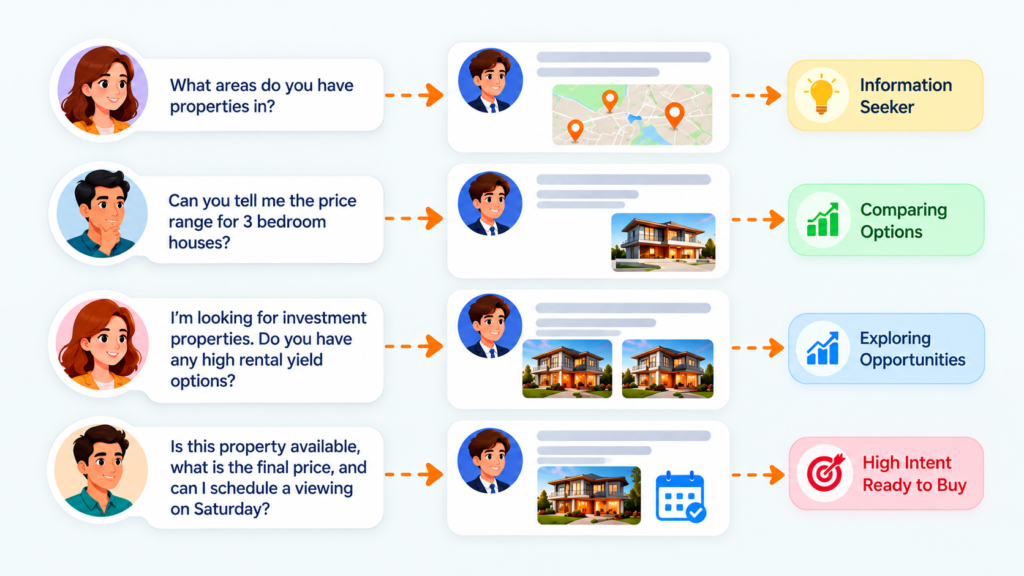
One of the most useful applications of chatbot in real estate is automated lead qualification.
Instead of asking every visitor to complete a long form, the chatbot can have a short, natural conversation based on what the visitor is looking for.
For example, it can understand:
- Property type
- Preferred location
- Budget range
- Number of bedrooms
- Buying or rental requirement
- Expected purchase timeline
The chatbot can then use these answers to determine what information should be collected and when a visitor should be connected with a salesperson.
This is particularly useful for real estate businesses receiving large volumes of enquiries, because sales teams don’t have to spend the same amount of time manually qualifying every visitor.
Help Buyers Find Properties Instead of Making Them Search
A common problem with real estate websites is information overload. A website may have hundreds of properties, but visitors often have to use filters, open multiple listings, compare details, and still contact an agent to get answers.
A chatbot can make property discovery more conversational.
For example:
“I’m looking for a 2-bedroom apartment near the city centre, with parking, under $300,000.”
The chatbot can use the available property information to narrow down relevant options and explain why they match the visitor’s requirements.
This is more useful than simply showing a search box because the visitor can describe what they want in their own words.
Answer Questions Before They Become Lost Leads
Many potential buyers leave a website because they cannot find an answer quickly.
They may want to know:
- Is this property still available?
- What is the price?
- What amenities are included?
- Is parking available?
- Where exactly is the property located?
- Can I schedule a viewing?
- What documents are required?
AI customer service for real estate can answer common questions immediately instead of making visitors wait for an agent.
This matters because a visitor who gets an answer immediately can continue exploring properties, while a visitor who has to wait may simply leave the website and look elsewhere.
Give the Chatbot Access to Real-Time Business Data
The usefulness of an AI chatbot depends heavily on the information it can access.
A chatbot trained only on static website content may be able to explain property features, but it may not know information that changes frequently.
Connecting the chatbot to APIs or business systems can allow it to retrieve relevant information when a visitor asks for it.
For example, instead of simply saying that a property exists, the chatbot could potentially check connected business data and provide the latest available information.
This turns the chatbot from a basic FAQ tool into a conversational interface for the business’s information.
Give Salespeople the Conversation, Not Just the Lead
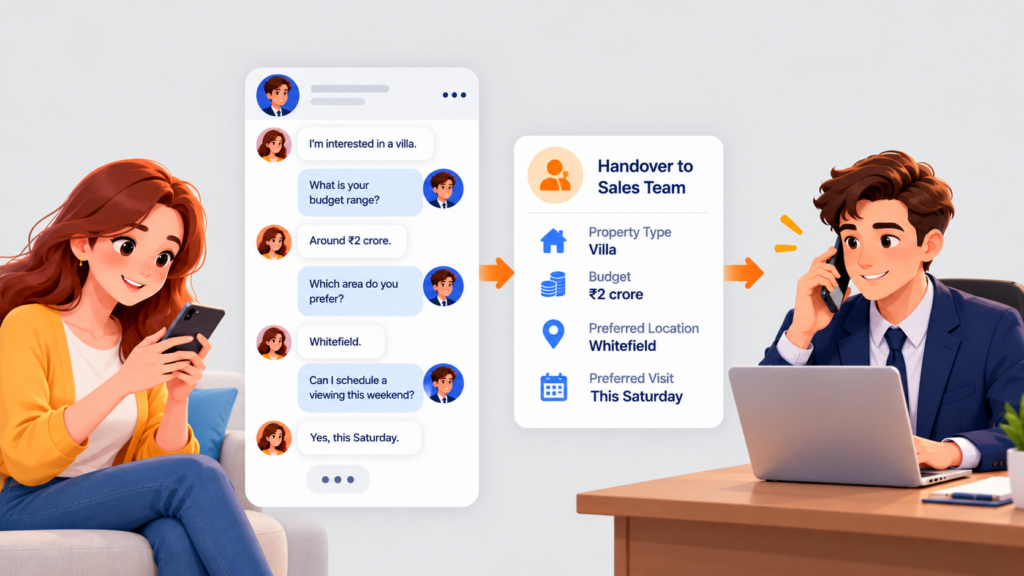
Lead forms create another problem: salespeople often receive the contact details without understanding the conversation behind the enquiry.
An AI chatbot can capture both the lead information and the conversation that produced it.
A salesperson could see:
Looking for: 3-bedroom apartment
Location: California
Budget: $500,000
Timeline: Within 3 months
Interest: Properties with parking
Now the salesperson can start with the customer’s actual requirements instead of asking the same qualification questions again.
This reduces friction for both sides and gives sales teams a better starting point for follow-up.
Move High-Intent Visitors to the Next Step
The chatbot should not stop after answering a question or collecting an email address.
When a visitor shows clear buying intent, the conversation can move toward an action such as:
- Booking a property viewing
- Requesting a callback
- Scheduling a meeting
- Sharing contact information
- Connecting with a sales representative
- Requesting more information
This creates a direct connection between the website conversation and the sales process.
The important shift is from “Did we capture the lead?” to “Did we help the visitor take the next step?”
Learn Why Visitors Don’t Convert
The conversations happening on a real estate website can also reveal problems that traditional analytics may not show.
For example, businesses can identify questions visitors repeatedly ask, properties they frequently enquire about, information they cannot find, and points where conversations end without an action.
If many visitors ask about financing but the website provides little information about it, that is a content opportunity.
If visitors repeatedly ask whether a property is available, that may indicate a need to connect the chatbot with current property data.
The conversations therefore become a source of insight for improving both the website and the sales process.
What Changes With AI in Real Estate?
The biggest change isn’t simply putting an AI chatbot on a real estate website.
It is changing what happens after a visitor arrives.
Instead of a visitor browsing listings, filling out a form, and waiting for a salesperson, the website can start a conversation immediately.
The chatbot can understand what the visitor wants, help them find relevant properties, answer questions, qualify their requirements, and pass useful context to the sales team.
That makes a real estate AI chatbot more than a customer-service tool. It can become part of the lead-conversion process, helping businesses understand website visitors and move relevant prospects from interest to action.