AI for Ecommerce Sales: How AI Can Turn Customer Conversations Into Revenue

Ecommerce businesses already have access to a huge amount of customer data.
You know what customers search for, which products they view, what they add to their cart, and where they leave.
The challenge is turning all of this information into better customer experiences and more sales.
This is where AI for ecommerce sales can make a real difference.
AI can help customers find the right products, personalise their buying experience, provide instant answers, understand customer behaviour, and reduce repetitive work for customer service teams.
Help Customers Find the Right Product
Customers don’t always know which product they need.
They may know their budget, requirements, or use case but still have difficulty choosing between several products.
AI can understand what the customer is looking for and recommend products based on their needs.
For example:
“I need running shoes for trail running under $150.”
Instead of making the customer browse through hundreds of products, AI can identify suitable options based on their requirements.
This makes product discovery faster and can reduce the friction that often leads to customers leaving without buying.

Personalise the Buying Experience
Not every customer should have the same buying experience.
A first-time visitor may need product information, while a returning customer may already know what they want. Another customer may be looking for a particular size, colour, price range, or use case.
AI for eCommerce can use customer behaviour and conversations to make recommendations more relevant.
It can understand what the customer is trying to achieve and guide them toward products or information that match their needs.
This is one of the practical uses of conversational AI for ecommerce.
Instead of forcing customers to navigate through multiple filters and pages, they can simply explain what they are looking for.
Give Customers Real-Time Order and Shipping Information
“Where is my order?”
“When will it arrive?”
“Has my order shipped?”
These are common questions for ecommerce support teams.
A chatbot connected to order or shipping APIs can retrieve live information and provide customers with their current order or shipping status.
This means customers don’t always have to wait for a support agent or search through different pages to find an answer.
It also reduces the number of repetitive questions reaching customer service teams.
Understand Why Customers Drop Off
Analytics can tell you where customers leave your website.
AI can help you understand what may be happening behind that behaviour.
For example, if customers frequently leave after viewing a particular product, there may be information missing from the product page.
Customer conversations can provide additional clues.
Customers may repeatedly ask about delivery, returns, compatibility, sizing, pricing, or product differences.
These questions can reveal the information customers need before they feel comfortable buying.
AI can analyse these patterns across conversations and customer behaviour to help businesses identify potential friction points in the buying journey.
Reduce Repetitive Customer Service Questions
Customer service teams spend a lot of time answering the same questions.
Shipping information, returns, product availability, sizing, order status, and basic product questions can make up a large number of support conversations.
An AI chatbot for ecommerce sales can handle many of these questions automatically.
But it shouldn’t simply work like a traditional FAQ.
It can understand the customer’s question, use the company’s knowledge, retrieve information from connected systems, and provide a relevant response.
When a conversation needs human attention, it can hand the customer over to a support or sales representative.
This allows human teams to spend more time on complex issues.
Turn Customer Conversations Into Sales Opportunities
Customer questions can also reveal buying intent.
Someone asking about delivery may be close to purchasing.
Someone comparing two products may need help making a decision.
Someone asking about bulk pricing may represent a larger sales opportunity.
AI can identify these signals and help move the conversation forward.
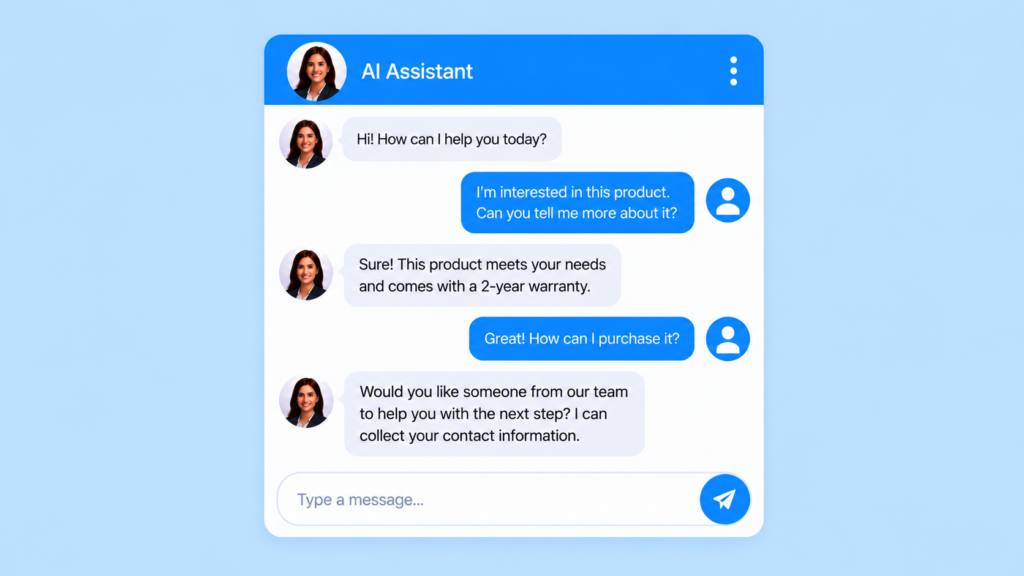
For example, instead of simply answering a question about bulk pricing, AI could capture the customer’s details or connect them with the sales team.
This is where AI for ecommerce sales becomes more than a customer support tool.
It becomes part of the sales process.
Connect AI With Your Ecommerce Data
The biggest opportunity is not simply adding an AI chatbot to a website.
It is connecting AI with the information your business already has.
Product data can help AI recommend the right products.
Customer conversations can reveal buying intent.
Analytics can show where customers drop off.
Order and shipping APIs can provide real-time information.
Support conversations can reveal recurring customer problems.
When these sources work together, AI can help create a buying experience that is faster, more personalised, and easier for customers.
Final Thoughts
Conversational AI for ecommerce is not just about answering customer questions.
It can help customers discover products, get personalised recommendations, receive real-time order information, and get answers without waiting for support.
For ecommerce businesses, it can also provide valuable insights into customer behaviour, reduce repetitive support work, identify buying intent, and uncover friction in the customer journey.
The goal isn’t to add AI simply because it is new technology.
The goal is to use AI to understand customers better, remove obstacles from the buying journey, and turn more customer interactions into sales opportunities.